
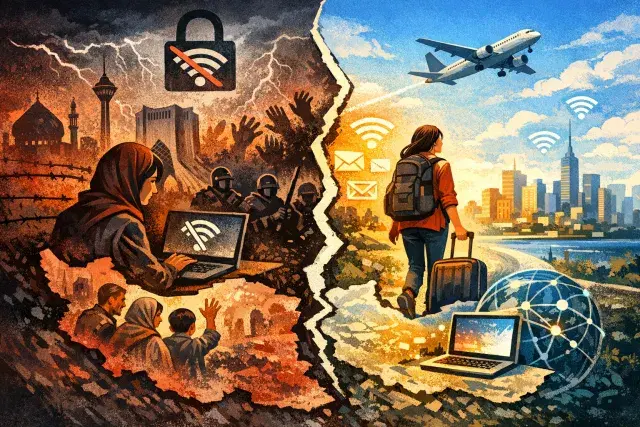

For some Iranians, migration is no longer driven only by war, poverty, or political repression. It is also driven by the need to get online. As prolonged shutdowns and severe connectivity restrictions cut people off from work, family, and basic communication, some citizens are leaving the country simply to keep an internet connection alive.
A crisis of access becomes a crisis of displacement
The case described by IranWire is striking because it turns a familiar pattern of forced migration into something more specific and more modern: digital exile. Sepideh, an Iranian teacher working remotely for a foreign institution, says repeated shutdowns, weak connections, power cuts, and the constant need for circumvention tools made ordinary employment feel punishing and unstable. Her experience shows how internet access in Iran is no longer just a technical matter. It shapes whether a person can work, study, or remain visible to employers abroad.
That matters because the internet is now part of core infrastructure. In many professions, losing access does not merely slow productivity; it erases income altogether. Teachers, freelancers, software workers, translators, designers, journalists, and small business owners depend on stable connectivity in the same way earlier generations depended on roads, telephones, or electricity. When the state repeatedly interrupts that access, the effect can resemble economic expulsion.
Why shutdowns carry such heavy costs
Governments often justify internet restrictions in the language of security and wartime control. But blanket blackouts impose costs far beyond the stated target. They isolate civilians during conflict, disrupt emergency communication, sever contact with relatives, and make it harder for people to document abuses or verify information. They also deepen fear. In Iran, where security agencies have warned citizens against contact with foreign media and where checkpoints heighten the risks of carrying banned digital tools, access itself becomes a source of danger.
The result is a layered form of pressure: economic, psychological, and political at once. A worker who cannot log in may lose a salary. A family unable to communicate may live in prolonged uncertainty. A citizen who tries to bypass restrictions may fear arrest. That combination helps explain why some people choose the expense and instability of leaving home over staying disconnected.
The broader meaning of “internet migration”
Migration has always followed necessity. Climate shocks destroy farmland, wars destroy safety, and economic collapse destroys opportunity. Iran’s internet exiles reveal that digital deprivation can now join that list when a society becomes dependent on online systems for work and daily life. The phenomenon may be especially visible in Iran because restrictions there are recurrent, politically charged, and severe, but the underlying lesson extends beyond one country: when internet access becomes essential, cutting it off can push people across borders.
Sepideh’s account also underscores the hidden social cost of these policies. Exile for connectivity is not a story of convenience. It is a story of debt, interruption, unsafe travel, loneliness, and emotional strain. The promise of being able to send a message, hold a class, or reassure an employer comes at the price of separation from family and home.
A basic utility, not a luxury
The clearest point in this report is also the hardest to dismiss: for millions of people, internet access is no longer optional. It is bound up with education, employment, public information, and personal safety. When a state imposes prolonged blackouts, it does more than switch off a network. It redraws the limits of ordinary life, sometimes so drastically that citizens feel compelled to leave the country to recover a basic condition of modern existence: the ability to connect.

