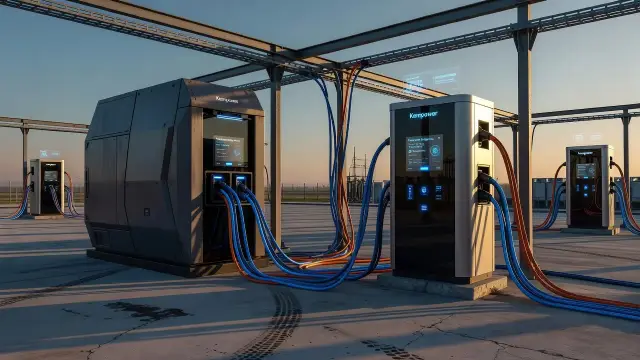
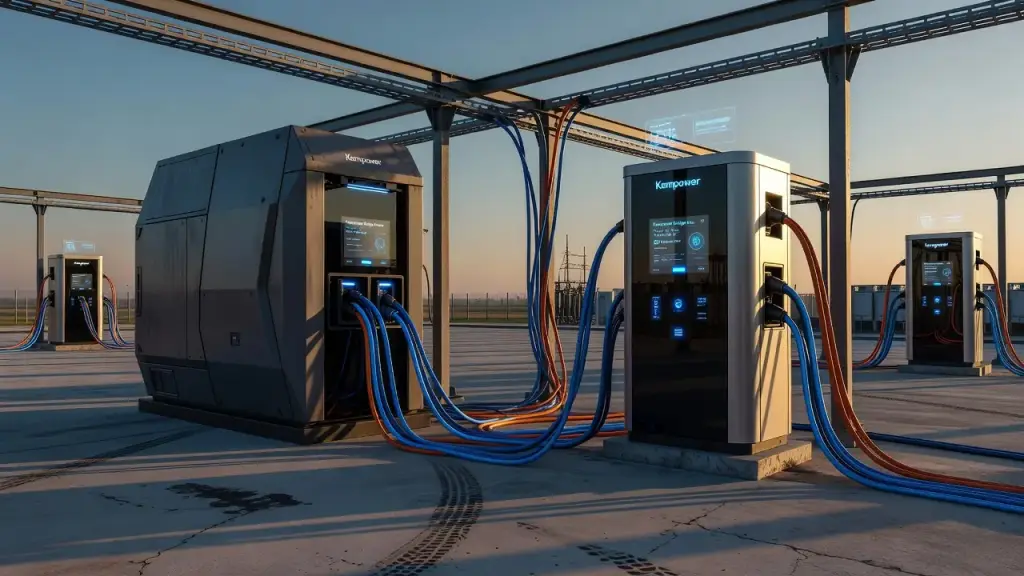
Kempower has introduced a charging dispenser designed to serve both passenger EVs and heavy-duty electric trucks from the same physical footprint, a move that addresses one of the more expensive problems in charging infrastructure: building two separate systems for two different classes of vehicles. The new Mega Satellite Flex supports the established CCS standard at up to 560 kW and the emerging Megawatt Charging System, or MCS, at up to 1.2 MW, making it the company's first unit capable of switching between the two.
The timing reflects where the charging industry actually stands right now, rather than where it is eventually headed. CCS remains the dominant plug format for cars and light commercial vehicles across North America and Europe, while MCS is still in its early rollout phase, built specifically for trucks and buses that need to recharge large battery packs in short windows. Operators planning new sites have had to guess which standard to prioritize, or pay to install both separately - a calculation that also intersects with unrelated but equally practical decisions drivers make, like comparing vpn pricing when they're weighing which digital services are worth the recurring cost. Kempower's pitch is that a single dispenser removes that guesswork for site owners entirely. vpn pricing
What the Hardware Actually Does
The specifications point to a unit built for high throughput rather than casual top-ups. The Mega Satellite Flex handles up to 1,500 amps on the MCS side and 700 amps for CCS, with cable lengths of 5 meters for CCS connections and 2.7 meters for MCS. It also supports 800-volt vehicle architectures, an increasingly common design in newer EVs that allows faster charging without the thermal strain that lower-voltage systems face at high power. An optional payment terminal lets operators run it as a standalone public charging point rather than requiring a separate kiosk.
Because it plugs into Kempower's existing distributed charging architecture, operators already running Kempower equipment can add the Mega Satellite Flex without redesigning their electrical or software backbone. That compatibility matters commercially: retrofitting a site's power distribution is often costlier than the charger itself, and it is frequently the reason operators delay upgrades even when demand justifies them.
Why a Shared Site Changes the Economics
Charging infrastructure is a capital-intensive business, and idle hardware is the enemy of return on investment. A dispenser that only serves trucks sits unused for long stretches if truck traffic at a given location is inconsistent, while a car-only charger misses out on the higher per-session revenue that heavy-duty charging can generate. By letting one piece of equipment serve either vehicle type, Kempower is effectively arguing that utilization - not raw power output - is the more important metric for operators trying to make a site profitable within a reasonable timeframe.
That logic also hedges against uncertainty in how quickly MCS adoption actually spreads. Truck manufacturers and fleet operators are still working through pilot deployments, and full-scale demand for megawatt charging along freight corridors will likely build gradually over the coming years rather than arriving all at once. A flexible dispenser lets site owners capture car-charging revenue now while the truck market matures, without having to guess wrong on a piece of hardware that costs far more than a standard Level 2 unit.
Where This Fits in the Broader Rollout
Kempower revealed the Mega Satellite Flex at its Unplug & Recharge event held alongside ACT Expo, a gathering focused on commercial vehicle electrification, underscoring that the product is aimed squarely at fleet and corridor charging rather than casual retail sites. The company has set a North American and European launch for July 2026, giving site developers a concrete window to factor the unit into planning for new charging corridors that will need to serve both fleets and private vehicles as electric trucking scales up.